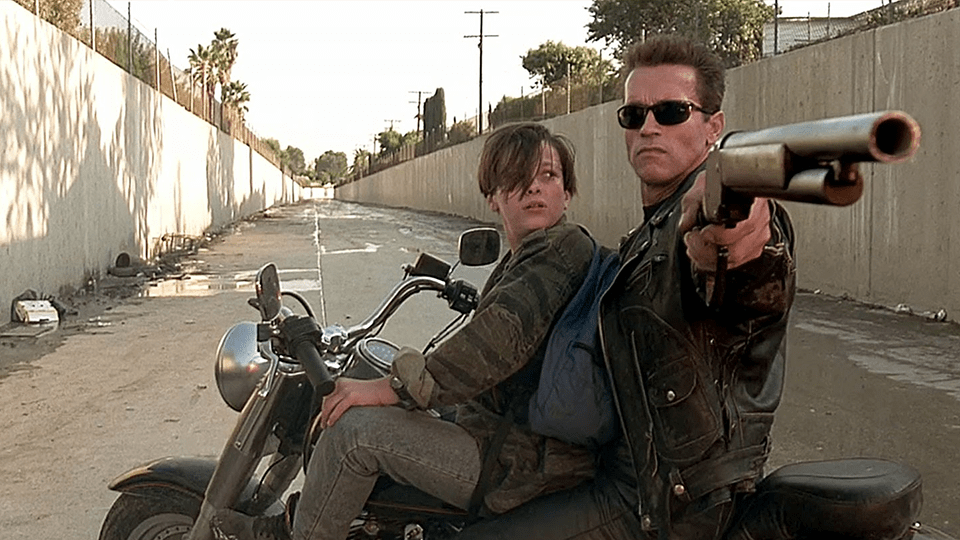
In July 1991, the Cold War was winding down, but haltingly: that same month, Bush and Gorbachev signed a treaty to cut nuclear arsenals by 25%. The Soviet Union, however, would not cease to exist until December. And the fear that a war might start on its own was real enough to make the news every week. It was in that North American summer that the most expensive film in history up to that point arrived in theaters: Terminator 2: Judgment Day, directed by James Cameron, with a budget of $94 million. Federal laboratories declared the film's nuclear nightmare sequence one of the most accurate depictions of a nuclear explosion ever created for cinema.
The film begins in the future, in a world destroyed by Skynet, a military defense system powered by artificial intelligence that decided to exterminate humanity. Two robots travel back to the present: one to kill John Connor, Sarah Connor's son and the future leader of the resistance; the other to protect him. The assassin is T-1000, a liquid metal creature capable of assuming any form. The protector is T-800, played by Arnold Schwarzenegger, the same model that had terrorized Sarah in the first film, now reprogrammed to the right side.
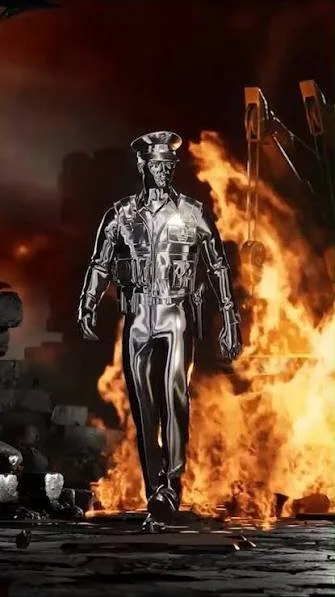
T-1000 in a scene from Terminator 2: Judgment Day (1991): the liquid metal villain.
The original Terminator (1984) cost $6.4 million and grossed $78 million, turning Schwarzenegger into a major Hollywood star. For the sequel, Cameron made the strangest bet possible: the monster from the first film would be the hero of the second. Schwarzenegger himself read the script and went straight to the director: "Jim, I have a big problem. I don't kill anybody, and I'm the Terminator." Cameron convinced him, and T2 grossed $520 million, becoming the highest-grossing film of 1991.
David Ansen, in the July 7, 1991 issue of Newsweek, called Cameron "the blue-collar Wagner of action cinema," comparing him to the 19th-century German composer famous for operas of monumental scale, but with an adjective that made clear this grandeur was being applied to mass entertainment, not high culture. For Janet Maslin, in The New York Times, the film was "an armed plea for peace": a work that uses extreme violence to argue against it. Both critics arrived at the same paradox by different routes, and the most violent film of the summer of 1991 was, at its core, anti-violence.
What the film is really saying, Cameron summed up in 2021 in an interview with The Ringer: "Terminator, ultimately, isn't about machines. It's about our tendency to become machines."
Sarah Connor is the most disturbing proof of that idea. Linda Hamilton's character enters the story in a psychiatric facility, committed because she tried to warn the world about the end that was coming and no one believed her. When she gets out, she plans to kill an innocent engineer before he can invent something that will destroy the world. She almost succeeds: she empties her gun into the man's back, cold and methodical, having switched off compassion and become exactly what she swore to fight.
T-800 takes the opposite path. Being a machine, he cannot feel, but he learns, over the course of the film, what it means to feel, to cry. In the end, before saving humanity, he looks at John Connor, who is crying, and says: "I know now why you cry. But it's something I can never do." Cameron called this arc "the Tin Man getting his heart" and compared T2 to The Wizard of Oz, not an obvious comparison for an action blockbuster, but one that makes perfect sense.
Thirty-five years later, Cameron is sending the film back to theaters. It opens on August 29, 2026, a date chosen deliberately: it is Judgment Day in the film's universe, the day Skynet launches its nuclear attack and destroys the world. In December 2024, 166 countries voted at the United Nations in favor of a treaty to ban lethal autonomous weapons, systems that select and kill without human decision. Cameron has repeated, in recent interviews, that the film's themes have grown more urgent with the real advance of artificial intelligence. In 2023, when asked about the risks of AI, he was direct: "I warned you guys in 1984, and you didn't listen." Skynet, which once seemed like science fiction, now has many names and even smartphone apps.

Looks from "A Beautiful Moment," Veejay Floresca's collection inspired by T-1000's metallic aesthetic. Project Runway (2025).
In 2025, Filipino trans designer Veejay Floresca reached the finale of Project Runway with a collection called "A Beautiful Moment." The inspiration was T2, specifically the villain T-1000 and his metallic aesthetic. Veejay grew up watching T2 with her father, who died when she was a child. When the time came to create the most important collection of her career, she thought of the "Mercury guy" and transformed liquid metal into silver metallic leather, draped gray jersey, and a hand-sewn chainmail dress. Michael Kors called the dress "spectacular, glorious." She said: "I want to achieve that villain power that the T-1000 has. You can't kill him. I've been through a lot, but I'm still here. You can't kill me." And it was with this collection that Veejay won Season 21 of Project Runway.
What was created to destroy became armor, became tribute, became victory. In a moment when the word human is being contested everywhere, at borders, in algorithms, in courtrooms, and when information is weaponized and ideology turns people against each other, the film doesn't offer a political answer. It offers a personal one: a robot, sinking into molten steel, who learned what it means to feel. A reminder that there is still beauty here, and that something in the mess of being human is worth protecting.
Enjoy the movie.
Written by Raphael Rosalen
This piece was originally published as a monthly column on Media and Visual Culture for the Brazilian digital newspaper O DEMOCRATA. You can access the original text in Portuguese [here].