
July is an unusual month. It lacks the energy of new beginnings and the comfort of endings. It’s a pause in the journey. A temporary gap in time. Perhaps for that very reason, it’s when we most feel the pressure of living within time. It’s no coincidence that we grew up hearing about “July holidays.” In both the Northern and Southern hemispheres, whether winter or summer, the body craves rest.
In 2025, July’s spotlight closes the first chapter of the year with dark tones, heavy chiaroscuro, and an atmosphere of chaos and destruction—like a compelling Greek tragedy, raising the stakes for an exciting second act. But reality isn’t quite so romantic, is it? We’ve reached midyear with a sense of stagnation, caught in a cycle of repetition. The months move along, but culture seems to regress. Not just through film remakes or fashion trends, but through something deeper: a weariness of speed, of the “24h online” way of life, of a present that never truly stabilizes.
In a recent column for the New York Times, writer Glynnis MacNicol (author of the memoir I’m Mostly Here to Enjoy Myself and host of the Wilder podcast) noted that we are culturally stuck in the 1990s—not just as fleeting nostalgia, but as a recurring pattern. Brad Pitt, Tom Cruise, Carrie Bradshaw, Gwyneth Paltrow, baggy pants, flip phones, flash photography—all of these persist as if time has stopped. MacNicol describes this as a “Generation X revenge.” But it may be more than that: a sign of exhaustion. The "now" has become a zone of hyper-consumption. Everything is a screen, everything is a meme; everything is a "tag," and everything is potential for performance. And in this excess of versions of ourselves, little remains of what can actually be touched.
Over the past few months, this question has been haunting me: what can I still hold in my hands? I am nearing the end of my doctorate. Years of study, thought, research... and all I will have at the end is a .DOC file, maybe a .PDF or an e-book. A file. A mix of invisible codes, words, and thoughts reduced to zeros and ones... And if the power goes out worldwide, everything vanishes in an instant. What's left for me?!
Then I started to go back. I bought an old iPod. One of the heavy ones, with physical buttons and no touch screen. I spent days downloading MP3s, organizing folders, creating a unique music library that is mine alone. I felt joy in transferring files to a device that needs to be charged with a cable. A device that doesn't listen to me, doesn't recommend for me, doesn't filter me... It just plays music and helps me escape the world for a few minutes. And somehow, that brought me back a bit of my physical self.
This gesture is not unique. It appears in details all around us: in bags, shop windows, parlor talk, and crowded subways. The Labubu—part stuffed animal, part psychedelic creature—has become a trend among urban youth, hanging as a keychain or mascot, symbolizing a style that also signifies belonging. Meanwhile, the morango do amor (candy-coated strawberry), a red caramelized dessert with the face of childhood, has moved beyond TikTok and now appears in bakeries, memes, and long lines. At first glance, a doll and a sweet seem unrelated. But both point to the same trend: a growing desire for tangible things you can hold, that crack against your teeth, and that take up space in the real world. In an age of identity-by-avatar and digital consumption, these symbols suggest an alternative language—one that still relies on a physical body.
In an era with countless options for digital representation, there's something subversive about carrying items that tear, get lost, or wear out—a doll, an old camera, an offline playlist. These objects don't update themselves; they demand presence. Perhaps that's why they are making a comeback, even as a form of resistance.
July exemplified this. It was a month when the present seemed to grow weary, and the past returned not as longing but as an alternative. Like we're saying: maybe the future they promised was too demanding. Maybe all we want right now is a shaky, blurred photo. And perhaps, in the end, it's within these blurred images that the future truly begins again.
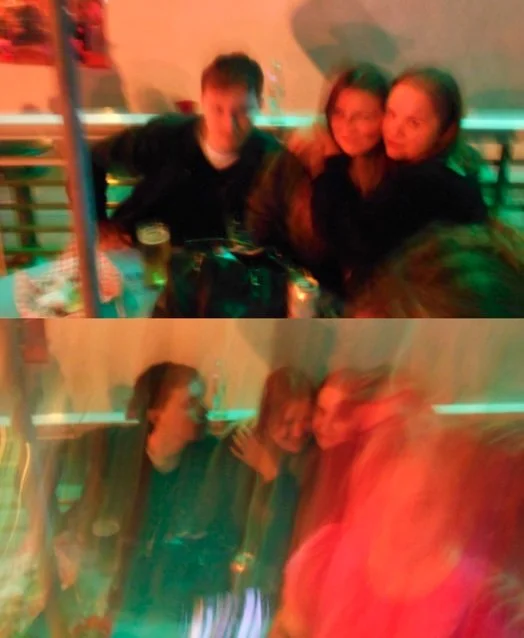
Photos by the author
Written by Raphael Rosalen
This piece was originally published as a monthly column on Media and Visual Culture for the Brazilian digital newspaper O DEMOCRATA. You can access the original text in Portuguese [here].