For every month in 2026, I’m revisiting a film celebrating an anniversary, using cinema to see how much the world has changed. Besides analysis, there's a simpler and perhaps more urgent reason: it's good for the soul to indulge in nostalgia. In today’s uncertain world, rewatching a classic is a form of self-care. After all, who doesn’t enjoy the comfort of a good movie after a long day? If you’re unsure what to watch today, join me. This April, our rearview mirror focuses on a film that, in 2001, seemed like a loud, colorful caricature, but today reveals itself as a raw and almost terrifying portrait of our digital control.
In April 2026, Josie and the Pussycats turns 25. At the time of its release, the film was considered a failure, grossing only $14 million against a $22 million budget. Critics of the time largely dismissed it as a "disposable juvenile product." It took us two decades to realize that the movie, written and directed by Deborah Kaplan and Harry Elfont, wasn't "silly"; but a sharp satire that is now celebrated as a cult classic for having accurately predicted the mechanics of our current capitalist and digital fatigue.
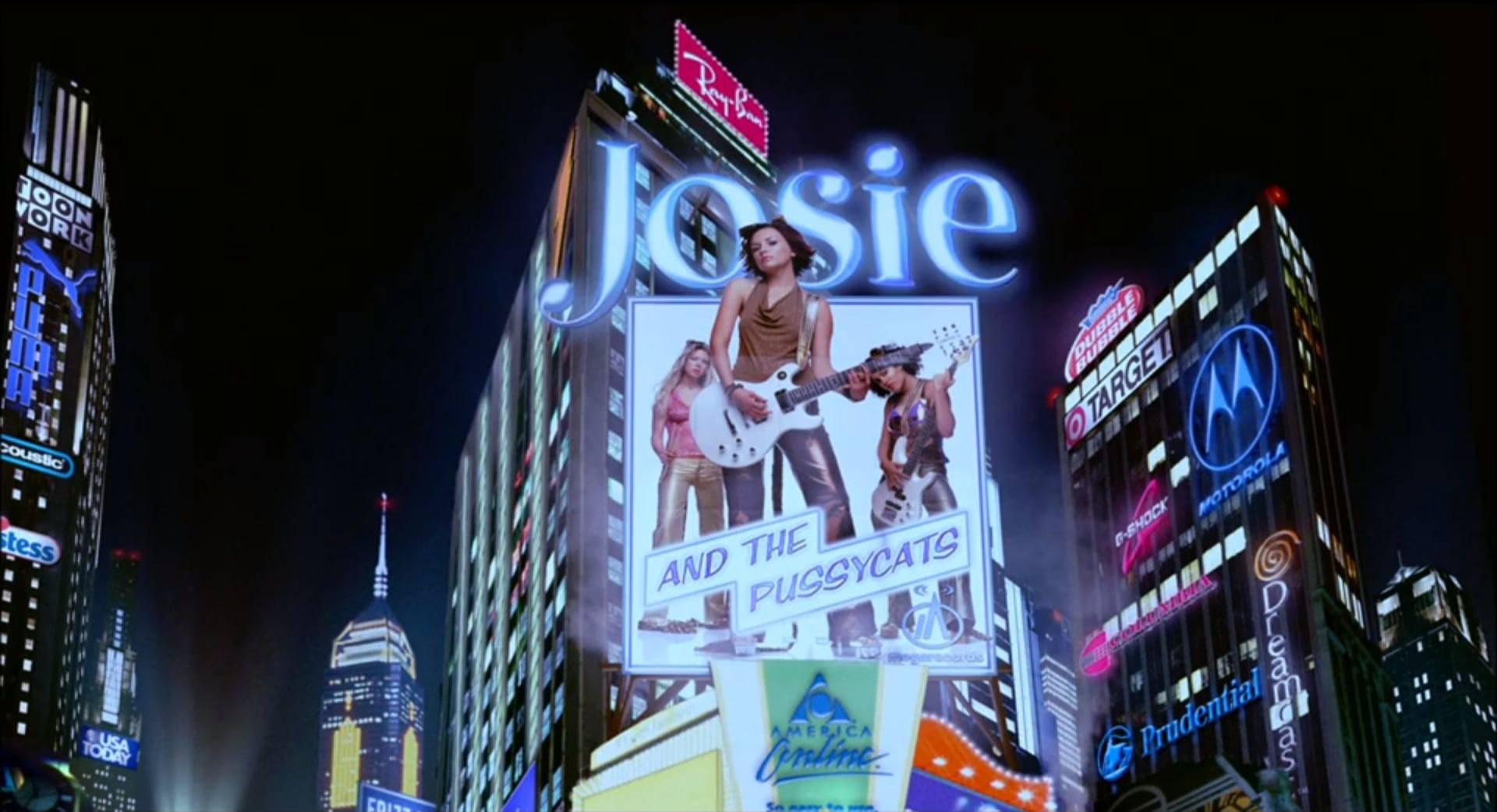
Based on the Archie Comics characters and the classic Hanna-Barbera cartoon, the film follows Josie (Rachel Leigh Cook), Melody (Tara Reid), and Val (Rosario Dawson), three friends dreaming of taking their rock band from the garage to the top of the charts without losing their style or authenticity. Their dream seems to come true when they sign a contract with the powerful MegaRecords, but their rapid rise hides a sinister plan: the label is using the band as pawns to insert subliminal messages into their music to influence the behavior of American youth. There's a scene that perfectly illustrates this control: everyone is wearing pink, but as soon as a new song plays, a girl declares, “You guys, orange is the new pink!” Instantly, everyone switches to wearing orange clothes. The visual identity of an entire generation is replaced by an external, centralized, and invisible command.
The irony of the film is striking. Variety, one of the few outlets to praise the work upon its debut, called it "intoxicatingly clever." The film critiques mindless consumption while deliberately being filled with real brand logos. Even the soundtrack fell into its own trap: the songs, created to parody laboratory-made "bubblegum pop," were so good they became a genuine commercial hit, reaching #16 on the Billboard 200 in 2001. Additionally, the album was certified Gold in the U.S., selling over 500,000 copies. As the film demonstrates, the market is capable of consuming even the mockery directed against it.
But what does Josie and the Pussycats say to us in 2026? The subliminal messaging technology of the film is now called "algorithm." What was science fiction in 2001 has become our everyday reality on TikTok and Instagram. We live under the rule of micro-trends: aesthetics that emerge and vanish within 48 hours, forcing us into a constant "skin update" to avoid becoming outdated. Yesterday it was “brat”; today it’s “Midnight Sun”, and tomorrow it will be whatever other aesthetic the system chooses.
However, we must stop treating the "algorithm" as a ghost or a mathematical mystery. These recommendation systems are not neutral; they are segmentation tools created by large corporations with clear commercial goals: to keep you hooked on the screen and maximize advertising revenue. It's no coincidence that you want to wear "orange" today; it's the result of repeated A/B tests and relevance signals processed by billionaires who hold the monopoly on our attention.
The film warned us that "authenticity" would be the most valuable commodity of the future. Today, we are encouraged to perform a "real" and vulnerable life to generate engagement, but this vulnerability is shaped to please the code. In a way, we’re all "Pussycats" trying to maintain a contract with an invisible record label in Silicon Valley, where success depends on how well we dance to the thit song of the moment.
Revisiting Josie, Melody, and Val’s journey, the lesson for 2026 is clear: in a world where "orange" is dictated by algorithms aimed solely at profit, maintaining one's essence and real-life bonds is the greatest—and perhaps only—act of rebellion possible. In the end, the Pussycats chose friendship over the top of the charts. Perhaps we should try the same.
Enjoy the movie.
Written by Raphael Rosalen
This piece was originally published as a monthly column on Media and Visual Culture for the Brazilian digital newspaper O DEMOCRATA. You can access the original text in Portuguese here.