Throughout 2025, this column explored the chaos of the present—from the culture right now to the invasion of artificial intelligence in our daily lives. But for 2026, I suggest a new approach: each month, we'll revisit a film celebrating an anniversary, using cinema as a way to see how much the world has changed. Besides analysis, there's a simpler and perhaps more urgent reason: it's good for the soul to indulge in nostalgia. In today’s uncertain world, rewatching a classic is a form of self-care. After all, who doesn’t enjoy the comfort of a good movie after a long day? If you’re unsure what to watch today, join me. Let’s keep our journey going.
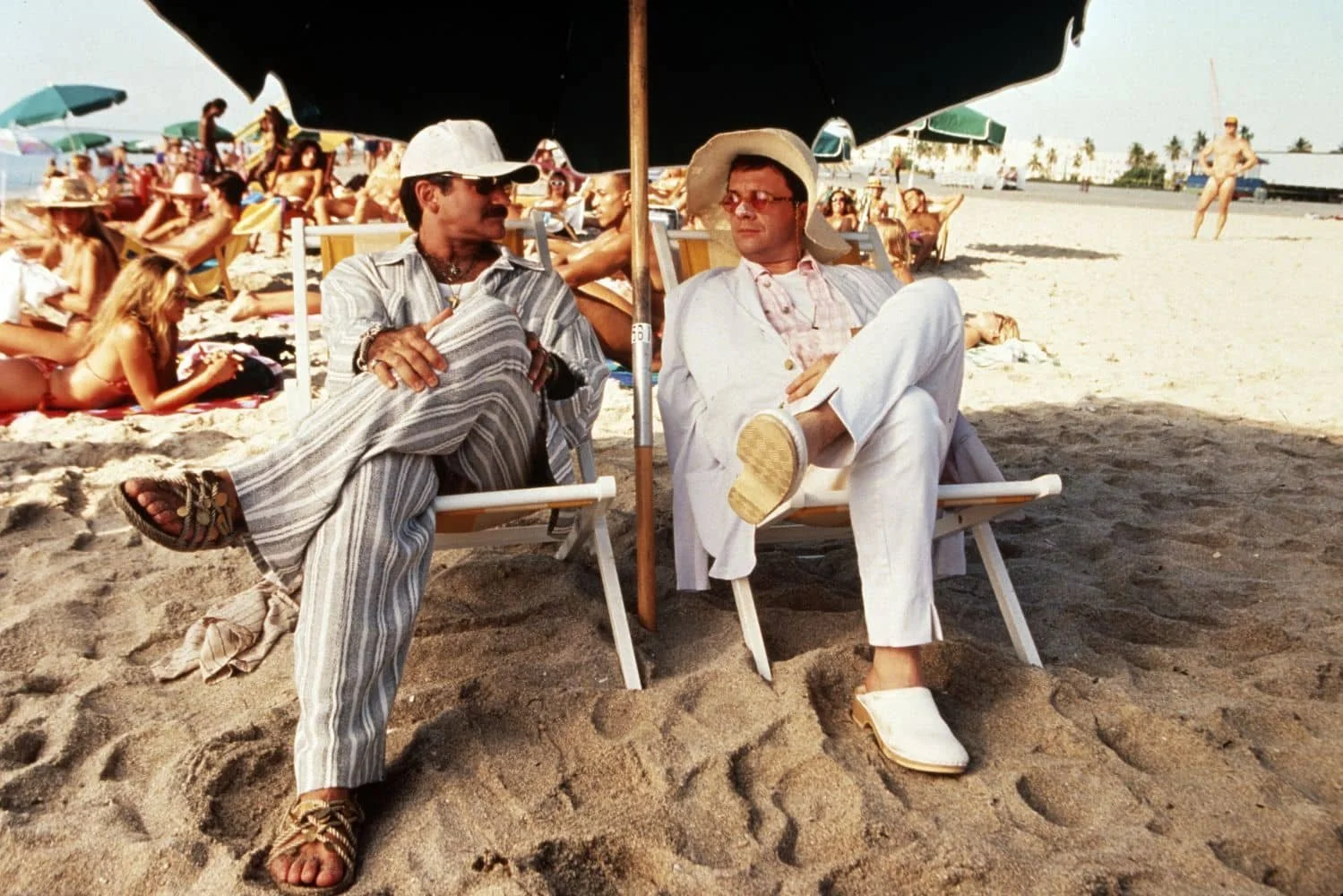
This month, we shift from psychological tension to pure catharsis. On March 8, 2026, The Birdcage turns exactly 30 years old. The premise of the 1996 film remains as absurd as it is brilliant: Armand (Robin Williams), the owner of a lively drag club in Miami, and Albert (Nathan Lane), the show’s star and his longtime partner, must pretend to be a conservative family for a dinner with their son’s future father-in-law — an inflexible, ultra-right-wing senator. The farce reaches its peak when Albert delivers his greatest performance yet: dressing as a conservative woman to pass as the "mother" of the family.
To bring this madness to life, director Mike Nichols assembled a cast that is an event in itself. We have Robin Williams at the peak of his charisma, fresh from hits like Mrs. Doubtfire, Jumanji, and Dead Poets Society. He is the perfect match for Nathan Lane—a Broadway legend whom audiences will surely recognize as the hilarious Pepper from the series Modern Family. The film also features Gene Hackman, immortalized as Lex Luthor in Superman and an Oscar winner for Unforgiven, alongside the unmistakable Christine Baranski (whom you surely love as Tanya in Mamma Mia! or the fabulous Martha May Whovier in Dr. Seuss' How the Grinch Stole Christmas). That is not even counting Hank Azaria stealing every scene as the indomitable Guatemalan houseboy, Agador.
At the time, it was uncommon for a major studio comedy focused on a gay couple to reach such wide commercial success. The film premiered in nearly two thousand theaters and earned over $185 million worldwide, becoming a true phenomenon. In 1996, the esteemed Entertainment Weekly described it as “ingenious and human entertainment”, highlighting that the story’s genuine emotional core was its powerful and deeply moving depiction of a monogamous domestic life.
To understand the magnitude of this achievement, one must remember that in the 1990s, mainstream cinema almost always associated the LGBTQ+ experience with tragedy, grief, or marginalization—painful reflections of the impact of the HIV/AIDS epidemic. Director Mike Nichols' most radical act was to go in the opposite direction, offering what he himself championed as "joyful visibility." He didn’t want to create a dramatic pamphlet about suffering; he wanted to show the glitter, the theatricality, and a life pulsing with energy. Ironically, he proved that behind the feathers and the nervous breakdowns, Armand and Albert formed the most devoted, loving, and stable family in history.
Nichols' greatest weapon was using the classic structure of the comedic farce as a literal "Trojan Horse." As critics pointed out at the time, in this film, "the joke and the message are the same thing." The comedy wasn't there to belittle the characters, but to invite the mainstream audience into the couple's living room to laugh with them, not at them. Laughter functioned as the master key to disarm prejudice.
Which brings us to 2026. Today, we live in an exhausted, armed, and deeply divided world, where public debate often turns into shouting matches, ideological trenches, and merciless cancellations on social media. Looking back at The Birdcage, we are reminded of a diplomacy tool we seem to have forgotten: open-hearted comedy. The film teaches us a vital truth: it is nearly impossible to hate someone with whom you are laughing until your stomach hurts. Clever, human humor builds bridges of empathy that anger can never create.
In a time when we are often encouraged to be cynical or fearful, the story of Armand and Albert shines as a bright reminder that joy is a powerful act of resistance. The world is much safer—and infinitely more enjoyable—when we set aside rigidity and choose to dance together at the end.
May cinema continue to be that safe space where laughter restores the humanity we all cherish.
Enjoy the movie.
Written by Raphael Rosalen
This piece was originally published as a monthly column on Media and Visual Culture for the Brazilian digital newspaper O DEMOCRATA. You can access the original text in Portuguese [here].