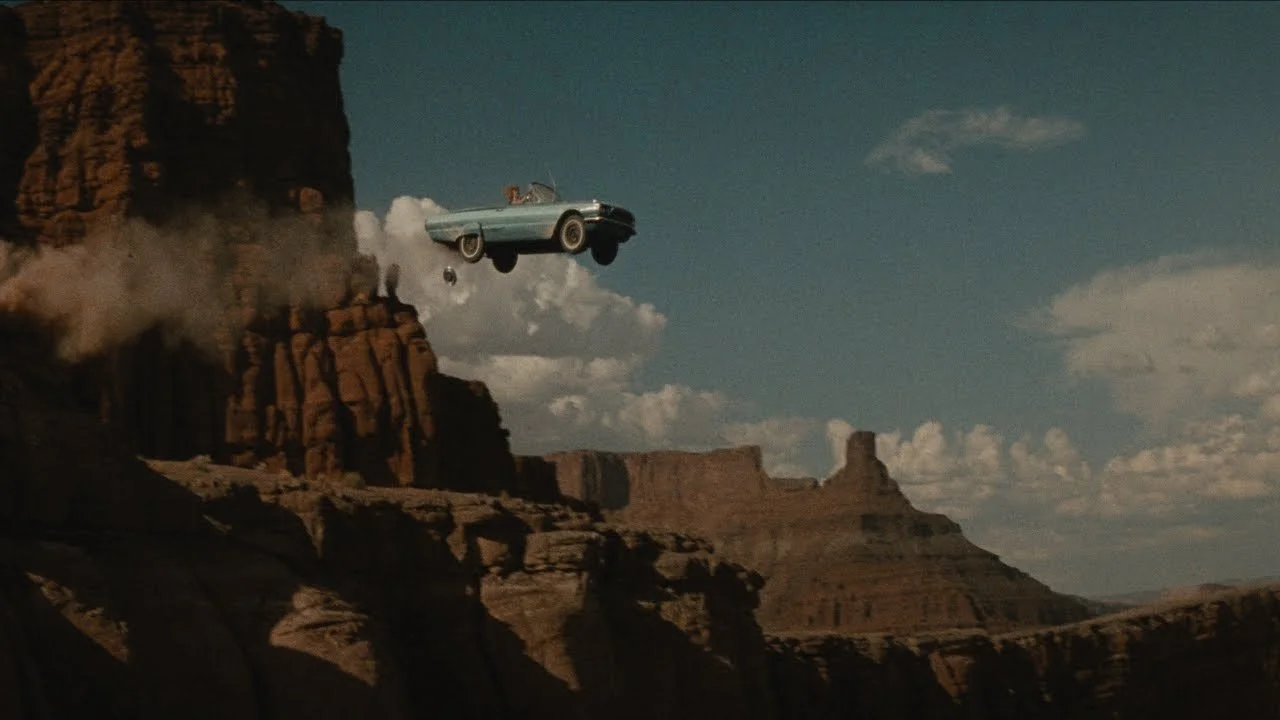
For every month in 2026, I’m revisiting a film celebrating an anniversary, using cinema to see how much the world has changed. Besides analysis, there's a simpler and perhaps more urgent reason: it's good for the soul to indulge in nostalgia. In today’s uncertain world, rewatching a classic is a form of self-care. After all, who doesn’t enjoy the comfort of a good movie after a long day? If you’re unsure what to watch today, join me. This May, Thelma & Louise turns 35. But the most remarkable thing isn’t the anniversary itself, but the fact that, in 2026, the film still provokes the exact same reactions it did upon its debut.
Los Angeles, May 2026. The city is still processing the hangover from Coachella—a festival that, this year, transformed the Indio desert into an altar for female liberation. But before we dive into that, let’s rewind a bit...
On May 24, 1991, Thelma & Louise—directed by Ridley Scott from an original screenplay by Callie Khouri—premiered in American theaters after a run at the Cannes Film Festival. The story is both simple and devastating: Thelma (Geena Davis), a suffocated housewife, and Louise (Susan Sarandon), a pragmatic waitress, set out on a road trip that turns into a fugitive flight after Louise kills a man attempting to rape her friend in a parking lot. From that moment on, the American Southwest—with its canyons, endless highways, and the orange skies of the Grand Canyon—becomes the stage for one of the most emblematic escapes in cinematic history.
Commercially, the film grossed $45 million in the U.S. alone—a considerable feat for a production that fit into no established market box at the time. Critics turned the release into a battlefield: The New York Times celebrated Ridley Scott’s then-untapped talent for exuberant comedy and vibrant Americana, while other outlets branded it “neo-fascist” and “degrading to men.” In June 1991, TIME placed Sarandon and Davis on the cover with the headline "Why Thelma & Louise Strikes a Nerve," creating one of the magazine's most iconic covers. The following year, Khouri took the Oscar stage as the first solo female screenwriter to win Best Original Screenplay. The Academy tried to treat it as fiction, but the world knew better.
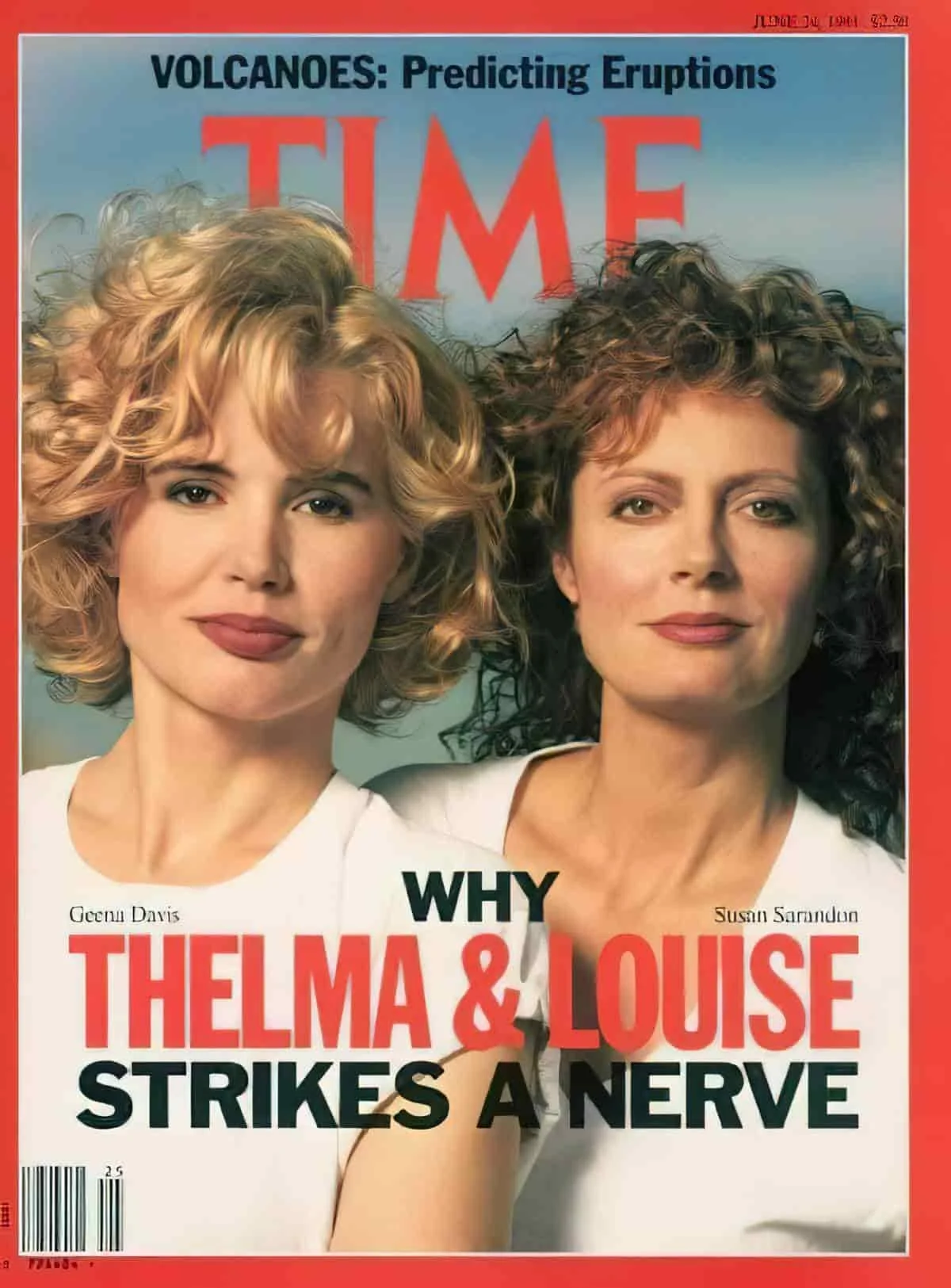
Geena David and Susan Sarandon on the cover of TIME magazine, June 24, 1991.
Beyond the career-defining performances of Sarandon and Davis, the cast brought a youthful surprise: a 27-year-old Brad Pitt, appearing for only a few minutes with a cowboy hat and a captivating smile, stealing every frame he occupied and launching one of Hollywood’s most enduring careers. Ridley Scott’s mastery lay precisely in this: transforming every element on screen into a permanent memory.
The film deliberately subverted what British critic Laura Mulvey termed the male gaze—the masculine perspective that historically objectified women in classical American cinema. In Thelma & Louise, it is Brad Pitt who exists as the spectacle and the two female protagonists who possess the gaze. By appropriating the language of the road movie—a historically masculine genre, from Easy Rider to Butch Cassidy—and putting two women behind the wheel, the film didn’t just flip a convention. It challenged the entire architecture of American cinema.
But now back to 2026 and Coachella. Sabrina Carpenter was one of the festival’s headliners, delivering a set that was both pop spectacle and cultural theater. During the first weekend, Susan Sarandon made a surprise appearance, pulling up to the arena in a vintage car at a makeshift drive-in, wearing a blonde wig: Louise summoned from the past to the California desert. During the second weekend, Geena Davis occupied the same driver’s seat, completing the tribute: Thelma and Louise symbolically reunited before an entire generation that wasn't even born in 1991. While some critics called the interlude a lull in the middle of a high-energy set, the symbolism was undeniable.
Susan Sarandon delivers incredible monologue at Sabrina Carpenter’s Coachella set pic.twitter.com/ukO9prE766
— Eser (@WrittenByES) April 11, 2026
And then came Madonna.
Madonna, who has been a pop icon for over four decades, appeared at Coachella wearing the same costume from her 2006 Confessions on a Dance Floor era to announce Confessions II, her fifteenth studio album, set for July 2026. The lead single, "I Feel So Free," is exactly what the title promises: a deep house declaration of liberty, with Madonna narrating the creation of a new version of herself on the dance floor. Her collaboration with Sabrina Carpenter, "Bring Your Love," released on April 30, connects three generations of women who refuse the boundaries the market insists on imposing.
The line connecting Thelma & Louise to Confessions II is more direct than it seems. In 1991, female freedom was represented as a road of no return: beautiful, impossible, ending at the Grand Canyon. Thirty-five years later, the metaphor has changed location: the dance floor has replaced the desert highway. But the resistance remains the same. What algorithms do today—dominating culture, dictating how women should age, what they should perform, and when they should vanish from the screen—is not so different from what the men surrounding Thelma and Louise did in that film: imposing an identity from the outside in, with no room for negotiation.
Madonna saying "I Feel So Free" in 2026 is Thelma and Louise flooring the accelerator in 1991. The vocabulary might be different, but the intent is the same. The difference is that in 2026, the "outlaws" have a dance floor, a microphone, and 35 years of road behind them. And they have no intention of stopping the car.
Enjoy the movie.
Written by Raphael Rosalen
This piece was originally published as a monthly column on Media and Visual Culture for the Brazilian digital newspaper O DEMOCRATA. You can access the original text in Portuguese here.