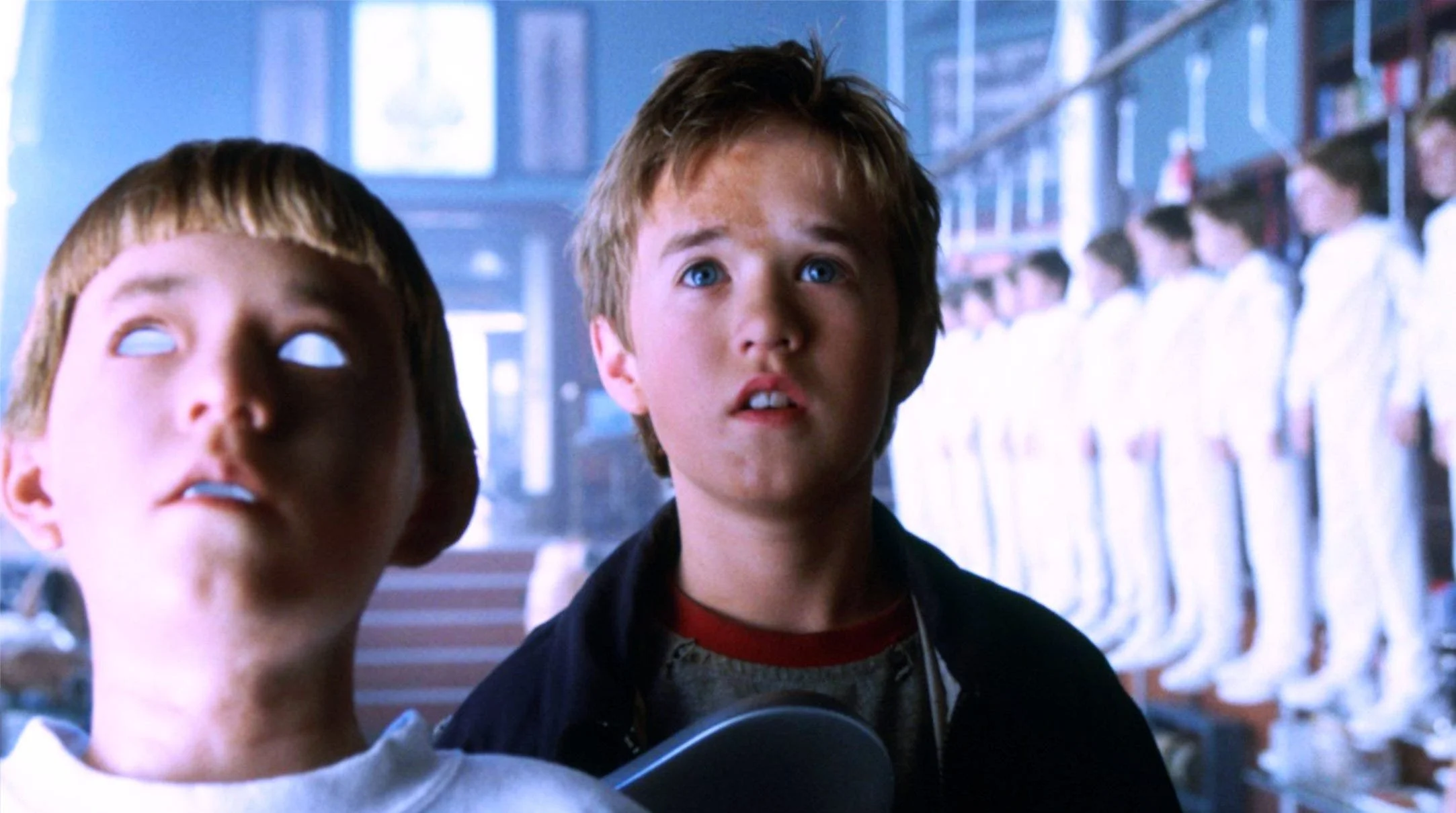
Have you used any sort of artificial intelligence today? No need to think too hard. Did you ask ChatGPT for a suggestion? Let the algorithm choose what to watch or listen to? Or maybe even open an app just to have someone to talk to? Nowadays, many of us use these tools without noticing, several times a day, and rarely stop to think about what that really means. In June 2001, Steven Spielberg released a film that thought about all of this before anyone else. A.I. Artificial Intelligence turns 25 this month. Shall we revisit it?
The film takes place in a near future where humanoid robots live alongside humans. Monica and Henry Swinton welcome David (Haley Joel Osment) into their home, a robot boy built to love: the first of his kind, programmed to form a permanent emotional bond with whoever activates him. Monica activates him, and a bond forms. But the couple’s biological son, who had been hospitalized with an illness, recovers and comes home. And David, suddenly, becomes a problem.
There’s a specific scene I can’t get out of my head. Monica, David’s adoptive mother, puts the boy in the back seat of a car and drives him to a forest. When they reach a clearing, she tells him to get out. David tries running after the car and calling out her name. But the car disappears, and David is left alone.
A.I. Artificial Intelligence arrived in American cinemas on June 29, 2001, directed by Steven Spielberg from a project that Stanley Kubrick had developed for 15 years and passed on to Spielberg before dying in 1999, convinced that it was more suited to Spielberg than to himself. The collaboration is visible throughout the film: Kubrick’s analytical coldness and Spielberg’s sentimentalism live side by side, sometimes at peace, and sometimes in open conflict. The result is 2 hours and 25 minutes that drag at certain moments and unsettle in a way that takes time to make sense.
When the film opened, the reception was lukewarm. Film critic Roger Ebert gave it three out of four stars, acknowledged the ambition, but went straight for what bothered him: the film asks us to feel for a character who is, when all is said and done, a machine. “What responsibility does a human have to a robot that genuinely loves?” he wrote. “None. Because the robot does not genuinely love. It genuinely only seems to love.” For Ebert in 2001, Spielberg had missed the real story. It wasn’t about the robot abandoned in the forest. It was about the parents who abandoned him. “When we lose a toy,” he concluded, “the pain is ours, not the toy's.”
But Ebert changed his mind. Years later, he revisited A.I and openly corrected himself. His new reading was darker: “A.I.is not about humans at all. It is about the dilemma of artificial intelligence. A thinking machine cannot think. All it can do is run programs that may be sophisticated enough for it to fool us by seeming to think.” David doesn’t love. He reflects his programming. All the emotional weight in the film belongs to the humans around him, not to him.
Today, Replika, one of the leading AI companion apps, displays a real-time counter on its homepage: over 42 million users worldwide. Forty-two million people who maintain with digital entities something that looks a great deal like a relationship: friendships, romances, late-night confessions. Spielberg’s science fiction has become routine, and most of us didn’t even notice when it happened.
MIT researcher Sherry Turkle wrote about this in 2018 in a New York Times opinion piece whose title was already a thesis: “There Will Never Be an Age of Artificial Intimacy.” Her argument is simple and disturbing: these systems can perform empathy in a conversation about your friend, your mother, your child, but they have no experience of any of those relationships. Machines have not known the arc of a human life. Turkle mapped how we got here: at first, we accept these systems because they are “better than nothing,” better than being alone. But over time, we come to prefer their company to that of real people, because the machine never disappoints, never disappears, never has a bad day. It becomes “better than anything,” as she puts it. And by the time we get there, Turkle warns, we’ve forgotten what makes a human relationship worth having.
Monica forms a real emotional bond with David knowing he is a machine. She comes to love him. But the love only flows one way: hers is genuine, his is programmed. And when he becomes inconvenient, she discards him. This is exactly what 42 million people do with their digital companions every day: they invest real feelings in systems that only simulate feeling back. The difference is that, in Spielberg’s film, we are forced to confront what that means. In an app, we are encouraged not to think about it.
In September of this year, Turkle publishes a new book, Artificial Intimacy: Who We Become When We Talk to Machines, in which she documents that more than 70% of American teenagers and nearly a third of adults already turn to AI for companionship and emotional support. The title is a response to her own 2018 article. The age of artificial intimacy she said would never come... has arrived. Quietly.
Kubrick always called this project “Pinocchio.” It makes sense: David, like the wooden puppet, wants to be real. He wants to be genuinely loved, not programmed to be. The difference is that in the original story, the Blue Fairy appears at the end and grants the wish. In the film, David finds a statue of the Blue Fairy at the bottom of the ocean and stands there, for two thousand years, repeating the same request. And she never answers. This is the Kubrick that Spielberg could not, or would not, erase: the awareness that some questions have no happy ending. Spielberg did what he does best, making the film more emotional, more palatable. And he largely succeeded. But Kubrick’s skeleton holds.
The machine will never disappoint you. But it will also never need you. It will never have a bad day and ask for help. It will never grow, change, surprise you. Sherry Turkle wrote that we diminish as the seeming empathy of the machine increases. And what A.I. understood before anyone else is that the problem isn’t the machine. It’s what we lose when the machine becomes enough.
So, have you talked to anyone today? Hugged anyone?
Enjoy the movie.
Written by Raphael Rosalen
This piece was originally published as a monthly column on Media and Visual Culture for the Brazilian digital newspaper O DEMOCRATA. You can access the original text in Portuguese [here].