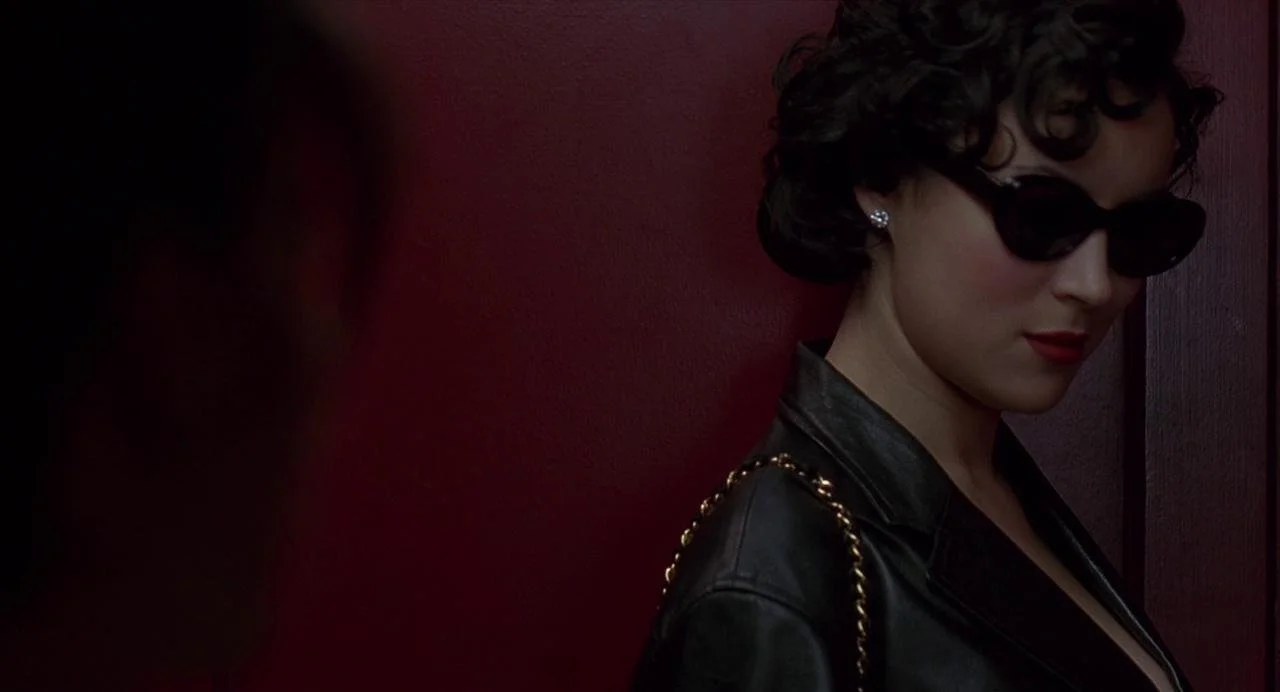
Before Bravo ever put a woman in front of a confessional camera and let her be glamorous, funny, and quietly in control of everything, there was Violet in Bound. The 1996 film that launched the career of the Wachowskis, later the creators of The Matrix, turns 30 this year, and watching it again, it's hard not to see Violet as the diamond-holding housewife before the diamond existed.
Here's the setup, for anyone who hasn't seen it (spoilers ahead, sorry!). Corky, played by Gina Gershon, is an ex-con just out of prison, taking a plumbing job in a building where Violet, played by Jennifer Tilly, lives with her boyfriend Caesar, a mob money launderer keeping around two million dollars of the family's cash in his apartment safe. Corky and Violet start an affair, then a plan: steal the money, make it look like Caesar took it himself, and disappear before anyone figures out what actually happened. By the end they're driving off together, the cash in the trunk. Caesar and the men circling him don't survive the night, but Violet and Corky are never even suspected. That ending alone was a big swing in 1996, when women in crime movies almost never got to just win.
But the ending isn't even the best part. The best part is watching how Violet gets there. She plays Caesar's girlfriend exactly the way he wants her: sweet, decorative, a little dim, completely harmless. But she's none of those things. She's reading every man in the building the entire time, and Caesar, who thinks he knows her completely, never sees any of it coming. It's a full performance, glamour and all, and she's the one running it. Tilly herself has said the role fit a type she recognized immediately: "a woman who is underestimated by all the men around her, and I don't have to do any research for playing that." She'd spent years playing exactly that kind of character for laughs, including an Oscar-nominated turn as a dim mob girlfriend in Bullets Over Broadway (1994), before Bound let her play it for keeps.
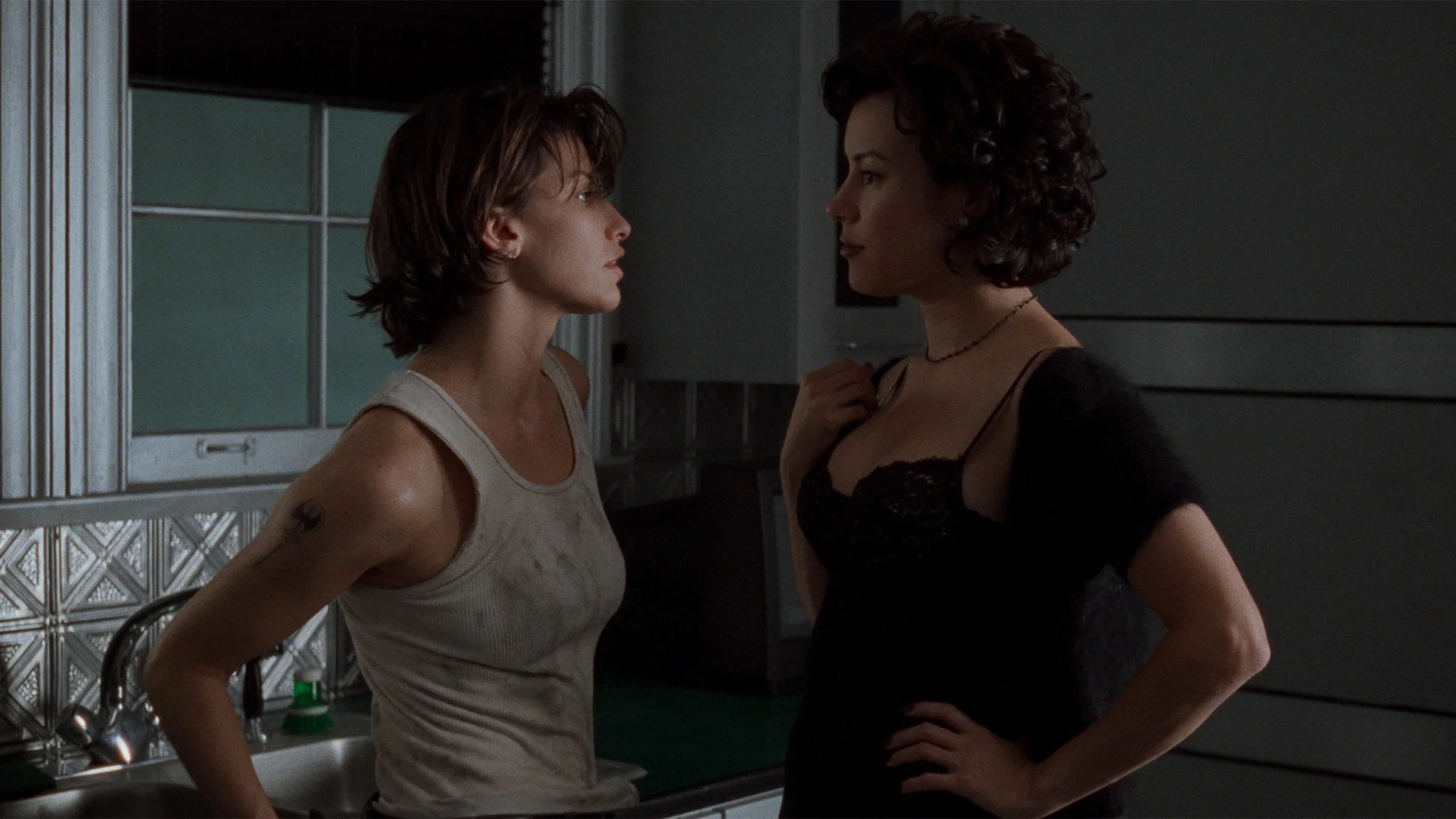
Corky (Gina Gershon) and Violet (Jennifer Tilly) in Bound
That's the part that feels so familiar now. Real Housewives has spent twenty years building an entire genre around exactly this, a woman who looks like she's just there to be glamorous and looked at, and turns out to be the smartest, most in-control person in the room the whole time. And it isn't only an attitude the franchise performs. Several actual Housewives have lived out a version of Violet's plot for real: Teresa Giudice went to prison for bankruptcy fraud and came back to the franchise anyway, she's still on it today. Jen Shah went to federal prison for running a telemarketing scheme and wasn't brought back. The persona doesn't automatically survive the crime. It has to actually work, in front of an audience, for that to happen.
Which makes it a genuinely fun coincidence that Jennifer Tilly is now on it. She joined The Real Housewives of Beverly Hills in 2024, and Bravo insiders are reporting she's about to be promoted to a full-time cast member for Season 16. The woman who played the prototype is walking straight into the world she predicted.
Jennifer Tilly in Real Housewives of Beverly Hills
She's got good company there, too. Erika Girardi appears on the show as "Erika Jayne," a glossy, larger-than-life pop persona, and that persona has done real work for her. It's kept her employed, visible, and telling her own story through a genuinely serious scandal. Her husband, Tom Girardi, from whom she's been separated since 2020 though their divorce has never been finalized, was one of the most powerful trial lawyers in the country before he was found guilty in 2024 of wire fraud, for stealing millions from his own clients, including settlement money owed to families of the 2018 Lion Air Flight 610 crash. Erika herself was never criminally charged, though a bankruptcy trustee sued her for $25 million, claiming she'd personally benefited from the stolen money. That case was headed to trial this past May and settled quietly, days before it started, with no verdict and no public accounting of who knew what. Through all of it, Erika stayed remarkably good at controlling her own story on camera. At one point she dismissed her husband's alleged victims outright, calling them merely "potential" victims who "may not be telling the truth." She played her TV role well enough to keep her show, her name, and her income through a scandal that would have ended almost anyone else's spot on it.
Violet got to have her ending in one movie and go home. Erika's still doing it, season after season, with no ending in sight, and she's still standing. There's a real question sitting underneath both of their stories, one the critic Laura Mulvey raised decades ago when she noticed that classic Hollywood almost always splits its characters into two kinds: the ones who do the looking, and the ones who exist to be looked at. Violet and Erika both seem to have flipped that arrangement, turning being looked at into the very tool they use to win. Whether that's actually a way out of the trap, or just a smarter way of staying inside it, is worth sitting with, since their whole advantage still depends on somebody watching. Maybe that's the real trick they've both pulled off: turning an audience's eyes into a weapon instead of a cage.
Maybe that's also what makes it so satisfying to watch. Part of it is simple: we're the one person in the room who's in on it, we know what Caesar doesn't, the way viewers know things the other Housewives don't. But there's something more personal in it too. Most of us get boxed in by some version of that same expectation eventually: decorative, harmless, not worth taking seriously, and most of us respond by shrinking, playing along, staying small enough to stay safe inside it. Violet and Erika don't shrink. They take the box and use it, flipping the exact thing meant to keep them small into the thing that wins. Watching that happen, boldly, in full view, is its own kind of pleasure, especially for anyone who's ever quietly done the opposite.
Thirty years ago, Bound handed us a woman who used every assumption people made about her to walk away with everything. Real Housewives, twenty years old itself this year, took that same idea and built an entire genre out of it, with real women and real-world consequences instead of a script.
Written by Raphael Rosalen
This piece was originally published as a monthly column on Media and Visual Culture for the Brazilian digital newspaper O DEMOCRATA. You can access the original text in Portuguese [here].